
Checking Criminal History in Fayette County
Begin a Fayette County criminal records search with the event you need to verify. Filed Circuit and District Court cases belong with the Fayette County Circuit Clerk. A recent booking belongs in the sheriff's current roster. A police narrative stays with the sheriff or city police department that wrote it. Statewide, fingerprint-linked history comes from the Alabama Law Enforcement Agency, or ALEA. These channels overlap, but none replaces the others.
Gather the full name, spelling variants, an approximate event date, and any known case or booking number. A date of birth can help the record holder distinguish similar names, although a public portal may not expose that field. Then follow the record from its source to its outcome. The court disposition deserves the most weight when an arrest charge and the final filed charge differ.
- Ask whether the needed fact concerns an arrest, current custody, a filed court case, or a statewide personal history.
- Check the matching official channel first: the sheriff feed, the clerk, Just One Look, or ALEA self-review.
- Match the name with an event date, case number, booking number, or other known detail.
- Compare the booking allegation with the court's later charge and disposition when both exist.
- Request a certified court copy or fingerprint-based personal record when ordinary search results are not enough.
For certification, older files, or a result that makes little sense, contact the Fayette County Circuit Clerk at 113 North Temple Avenue, P.O. Box 906, Fayette, AL 35555, 205-932-4617, from 8:00 a.m. to 5:00 p.m. on weekdays.
Four Fayette County Record Systems
Four systems answer four different Fayette County criminal history questions. The sheriff roster is a current-custody feed. The Circuit Clerk and Alabama trial-court services show filed cases. ALEA CHRI ties fingerprints to Alabama arrest cycles and reported outcomes. The Alabama Department of Corrections locator covers people now held in state prison. A person absent from one system may still appear in another because the scopes and update paths differ.
| Channel | Best use | Main limit |
|---|---|---|
| Sheriff roster | Current Fayette County jail custody | Not a case outcome or past-booking archive |
| Circuit Clerk and Just One Look | Filed charges, settings, actions, and dispositions | Not fingerprint-verified statewide history |
| ALEA CHRI | Reviewing one's own fingerprint-linked Alabama history | Older or unreported local records may be absent |
| ADOC Inmate Search | Current Alabama state-prison custody | Excludes local jail custody and historical releases |
The official Just One Look service shows how Alabama separates trial-court access from repository history.
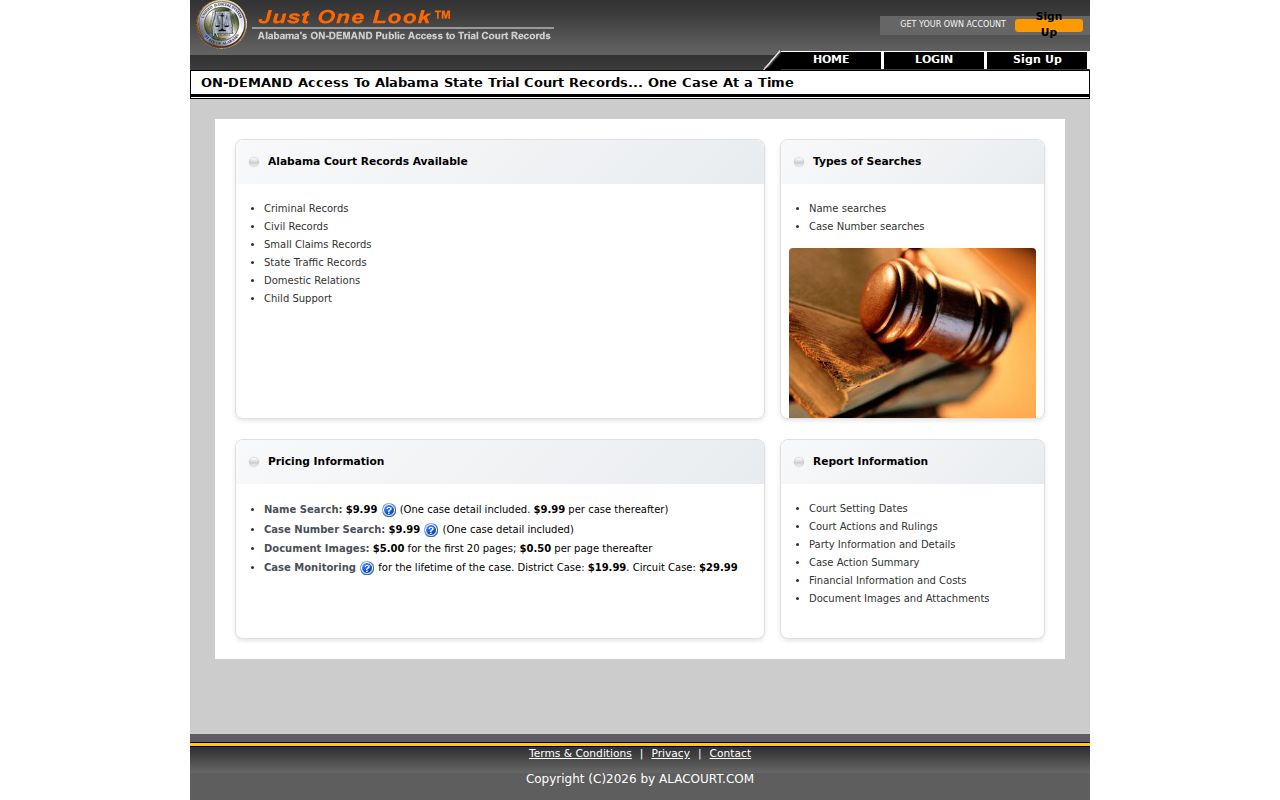
Its case detail can include status, settings, parties, financial history, and a case-action summary, but it is not an ALEA rap sheet.
Alabama Official Background Checks
A member of the public who wants to review their own Alabama criminal history uses ALEA's fingerprint-based Application to Review Alabama CHRI. The Alabama Background Check System is a secure service for qualifying, authorized subscribers, not an unrestricted public name search. For self-review, ALEA requires the application, classifiable fingerprints taken by authorized law enforcement with an FBI ORI, a current accepted photo ID, and proper payment.
ALEA charges $25 for the review and $5 for each extra certified copy requested with it. Payment must be a cashier's check or money order. The packet may be mailed to P.O. Box 1511, Montgomery, AL 36102-1511, or delivered at 301 South Ripley Street. ALEA lists five to ten business days as the minimum time after receipt. Fayette County does not publish a local fingerprint fee or appointment policy, so call the sheriff before making the trip.
The ALEA criminal-records program page is the official starting point for the state process.
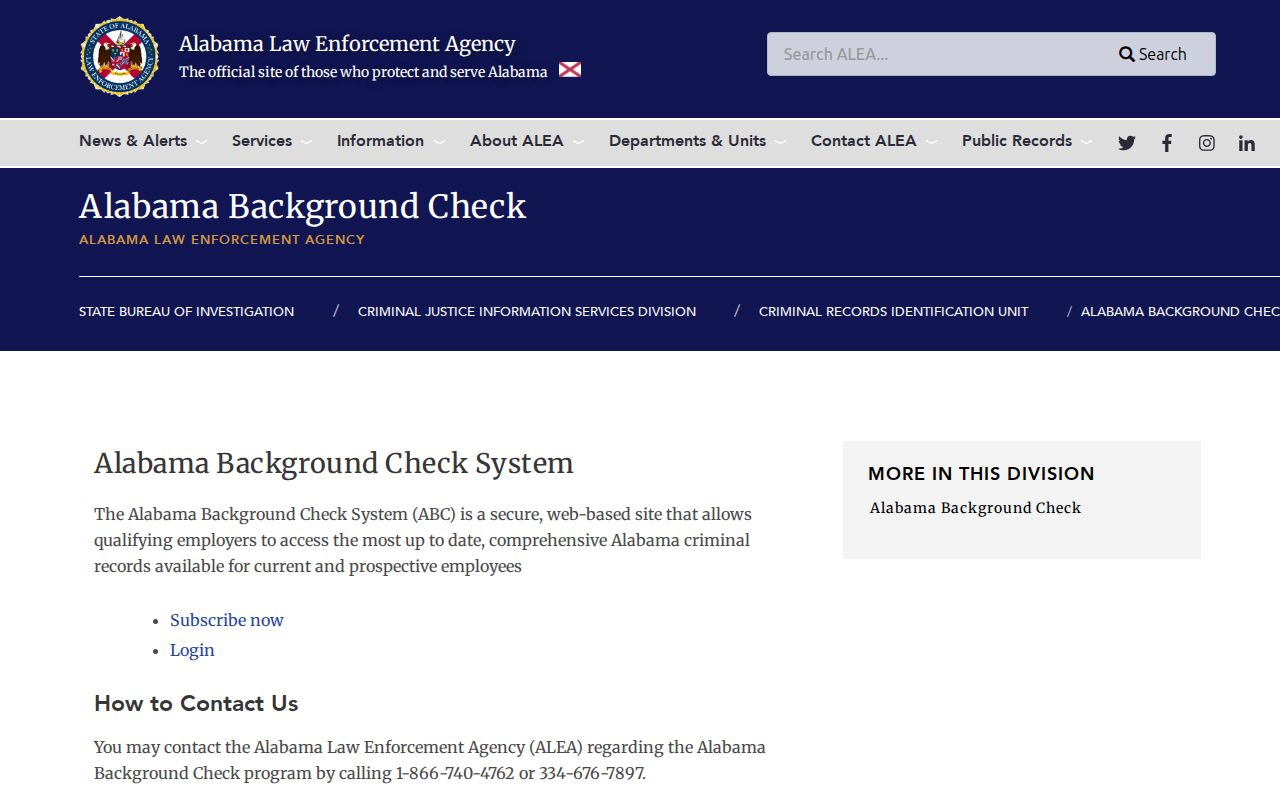
The state instructions help distinguish the restricted subscriber system from an individual's fingerprint-based review.
Reviewing Your Fayette County Record
The self-review packet is also the route for finding errors in one's own ALEA record. A challenge identifies each disputed charge, the arrest or disposition date, the arresting agency or court, the claimed error, and the proposed correction. Official support such as a certified Fayette County disposition can help ALEA check the report against its source. A challenge must be made within one calendar year of ALEA's response to the review request.
ALEA warns that challenges take longer because staff must contact the agency or court that originated the data. This matters when a Fayette County case was dismissed but the repository has no outcome. Start with the clerk for the certified case-action record, then send it through ALEA's review or challenge process. The local court record and statewide history remain separate even after they are compared.
| Official product | Fee | Scope |
|---|---|---|
| ALEA own-CHRI review | $25 | Subject's fingerprint-linked Alabama history |
| Additional ALEA certified copy | $5 | Extra copy with the same request |
| FBI Identity History Summary | $18 | Subject's fingerprint-linked federal summary |
| Just One Look case detail | $9.99 | Alabama trial-court case information |
The ALEA CJIS overview identifies the units that maintain state criminal record services. That structure explains why a Fayette County court file and an ALEA criminal history serve different record needs.
Criminal Record Types
A record's creator controls where a Fayette County criminal records request begins. Police and sheriff reports describe the event and enforcement response. The jail records intake and custody. Prosecutors and courts build the charging and case file. ALEA compiles fingerprint-linked Alabama history from agency submissions, while corrections and supervision offices maintain later custody or supervision data.
The same event can therefore leave several records. Each carries a distinct date, identifier, and purpose. An intake charge may change before filing, and a court disposition may reach the state repository later. Use the record that answers the question instead of treating a single name result as the whole history.
- Incident and arrest report: the narrative held by the agency that investigated or made the arrest.
- Booking record: the Fayette County Jail intake and current-custody entry.
- Court case file: the filed charges, motions, settings, orders, outcome, and sentence kept by the clerk.
- ALEA CHRI: a fingerprint-centered summary of reported Alabama arrest cycles and dispositions.
- Custody or supervision record: jail, ADOC, probation, parole, or community-corrections information within its legal access limits.
Fayette County Jail Record Limits
The Fayette County Sheriff's current inmate feed is a browsable list rather than a traditional search form. It shows ten entries per page in descending date order. An inspected, anonymized entry included a booking number, age, gender, race, physical descriptors, booking time, charge text, and an image or placeholder. It did not show bond, arresting agency, a statute, court date, release, or a final case result.
For a current custody check, browse the feed or use the Fayette County Sheriff mobile app. For a released or older booking, call the sheriff at 205-932-3205 and ask how to request the historical record. For the police narrative, go to the arresting agency. Once charges are filed, move to the clerk or the Fayette County criminal court case record to find the disposition.
The official Alabama Inmate Search begins at the state-prison level.
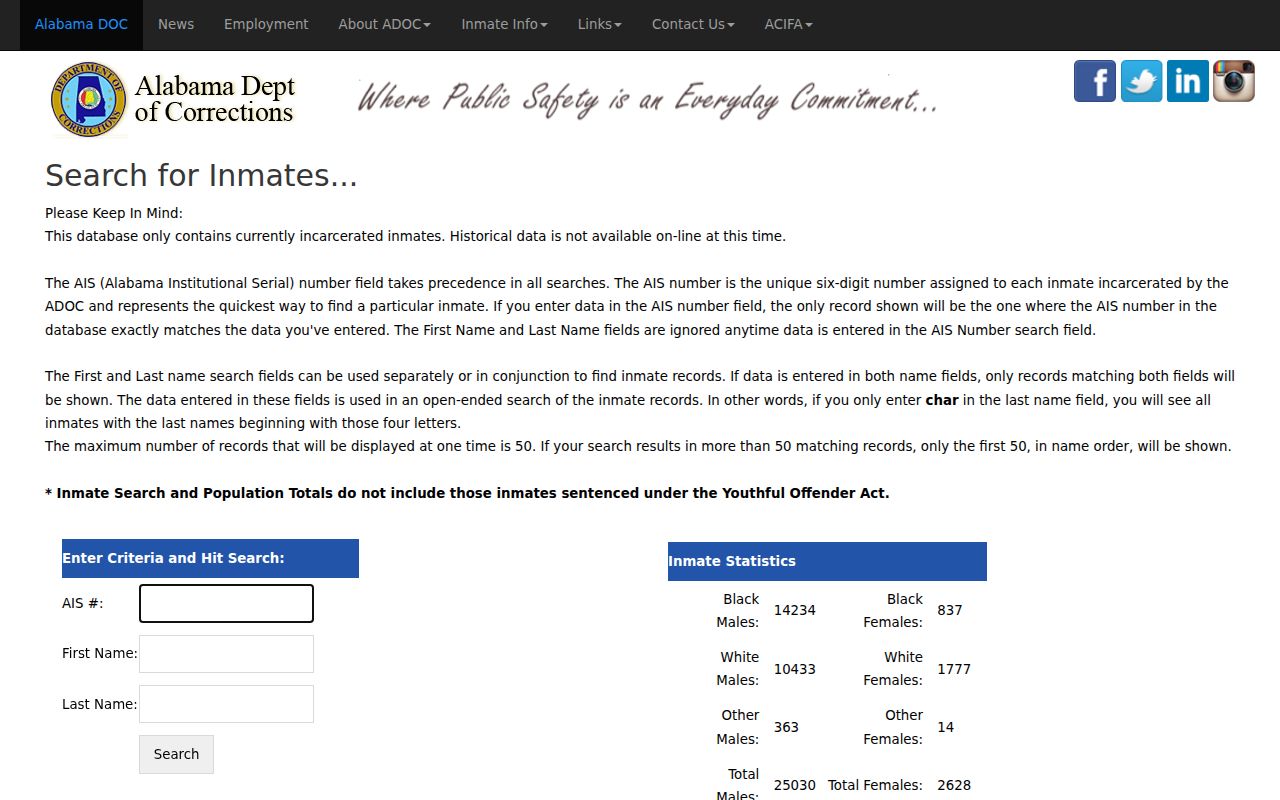
It accepts an AIS number or name and covers current ADOC incarceration, not a recent Fayette County booking or a historical county arrest.
Inside a Fayette County Criminal Record
The contents depend on the Fayette County criminal record being read. A booking entry focuses on intake and custody. A case detail focuses on the court, status, parties, settings, money entries, and action summary. ALEA CHRI may link identity data and fingerprints to an arrest cycle, charge, and reported disposition. Identifiers such as a court case number, booking number, Alabama SID, transmission control number, or ADOC AIS number belong to separate systems.
| Name and identifiers | Names, aliases, physical or identity data, and the source system's record number. |
|---|---|
| Arrest and booking data | Intake time, booking number, stated charges, and current custody information where published. |
| Charges and statutes | Initial allegations at arrest or the later complaint, indictment, or amended court charge. |
| Disposition | The result for a charge, such as dismissal, acquittal, plea, or conviction. |
| Sentence | Confinement, probation, restitution, costs, and other terms ordered after conviction. |
| Custody or supervision | Current jail or prison status and public court entries about probation or other ordered supervision. |
- Disposition
- The court's outcome for a charge.
- Nolle prosequi
- A prosecutor's decision to end a charge, subject to the status shown in the file.
- Case-action summary
- The ordered record of filings, settings, rulings, and other court events.
- Expungement
- Alabama's court process for restricting and archiving eligible charge records.
Fayette County Warrant Record Gaps
Fayette County has no official public active-warrant database. The court states that an arrest warrant is not public until served. A county magistrate handles felonies countywide and certain misdemeanors, traffic matters, and worthless checks outside municipal police jurisdiction. Inside-city misdemeanor matters often begin in municipal court, which is why asking only one county office can miss the issuing path.
A person who suspects their own warrant is directed to appear at the Sheriff's Department or the appropriate municipal police department. The sheriff is at 113 1st Avenue NW and can be reached at 205-932-3205. The clerk and warrants division is at 113 North Temple Avenue and can be reached at 205-932-4617. Confirm the current process by phone and consider legal advice before appearing. A served warrant may later show in jail or court data, but an unserved, sealed, or juvenile matter will not appear in an ordinary public search.
Note: A stale third-party warrant list cannot confirm whether a court has served, recalled, or otherwise changed a warrant.
Public Access Laws in Alabama
Alabama law starts with a resident's right to inspect and copy public records, then limits access when another law protects the material. Fayette County adult court information is generally available through the clerk or trial-court service, but juvenile, Youthful Offender, expunged, victim-identifying, privileged supervision, and security-sensitive information may be sealed, withheld, or redacted. Online access can also show less than the record held at the counter.
The Alabama Open Records Act does not turn a court docket into ALEA's fingerprint-linked repository record. It also does not authorize a person to obtain or share restricted offender information by false pretenses. Ask the office holding the original Fayette County criminal record when a result is missing or masked.
Key Alabama laws:
Ala. Code §36-12-40 gives Alabama residents a right to inspect and copy public records unless another law provides an exception.
Ala. Code §41-9-637 permits relevant identifying and historical information about people convicted and confined in qualifying custody.
Ala. Code §41-9-636 keeps criminal information subject to constitutional privacy and due-process limits.
Ala. Code §41-9-601 penalizes false-pretense acquisition or unauthorized communication of offender information.
Fayette County Supervision Records
Two local supervision programs are easy to confuse. The Alabama Bureau of Pardons and Paroles Fayette Field Office handles state-run adult probation and parole supervision at 110 Columbus Street East. The separate 24th Judicial Circuit Community Corrections Program is a court-linked prison alternative at 310 1st Court NW. It serves Fayette, Lamar, and Pickens Counties. The two offices have different duties and addresses.
A Fayette County court case-action summary may show a probation term, violation motion, revocation hearing, or discharge. The supervision file itself is not an ordinary public lookup. ABPP rules treat probation records as privileged and generally require an order from the sentencing court for production. Limited Board action sheets, hearing minutes, and other allowed records may be public, and ABPP maintains a public-record request process.
ABPP Fayette Field Office
110 Columbus Street East
Fayette, AL 35555
205-512-0796
Weekdays, 8:00 a.m. to 4:30 p.m.
24th Circuit Community Corrections
310 1st Court NW
Fayette, AL 35555
205-932-5624
Court-linked local alternative program
Sealed, Expunged, and Restricted Records
Alabama expungement can remove an eligible Fayette County charge from ordinary public access, but it does not mean every official archive or lawful investigative file vanishes. Courts and law enforcement retain access where Alabama law allows it. Juvenile and Youthful Offender records, victim data, account numbers, unserved warrants, and privileged probation or parole files also have separate limits.
Eligibility depends on the charge, outcome, time passed, prior history, and completion of required terms. Some dismissed misdemeanor, traffic, violation, or municipal charges can qualify after waiting periods set by Title 15, Chapter 27. Felony non-conviction routes use their own rules. A felony conviction route requires a pardon with restoration of rights and still excludes major categories. The court, not a search site, decides the petition.
Filing starts in the Circuit Court criminal division where the charge was filed. The statutory filing fee is $500 plus other court costs, generally for each arrest as required. An eligible person who cannot pay may submit an Affidavit of Substantial Hardship. The ALEA kit calls for certified CHRI, fingerprints, identification, and a certified arrest, disposition, or case-action record. The prosecutor or victim may object, which can lead to a hearing.
Fayette County Charge Record Trail
A Fayette County criminal record changes as it moves. An officer writes the arrest report. Jail staff create the booking. The 24th Judicial Circuit District Attorney decides what state charge to pursue, and the Circuit Clerk records the filed case. A judge may order jail, state custody, probation, or community corrections. Each step creates a new source without rewriting every older source.
The 24th Judicial Circuit District Attorney has criminal investigation, restitution, and victim-services functions that form part of this local trail.
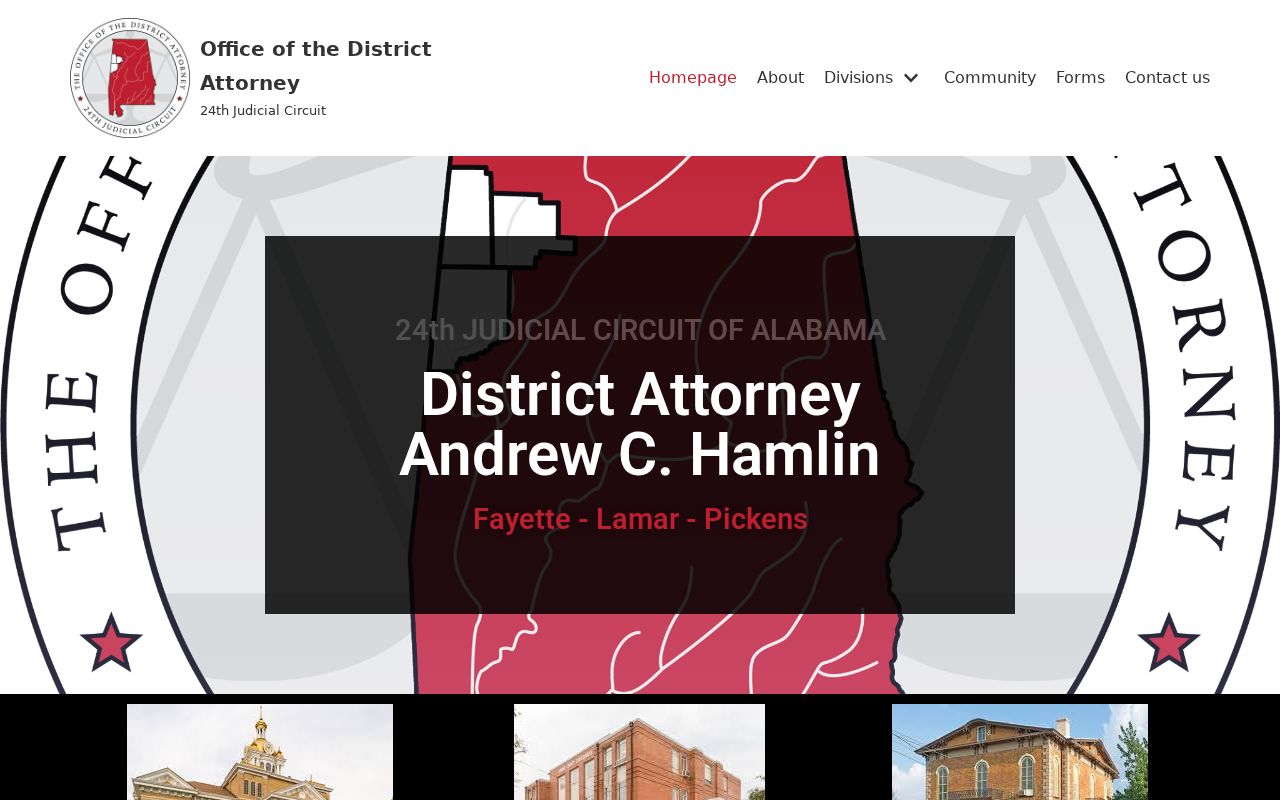
The office prosecutes state charges across Fayette, Lamar, and Pickens Counties, while municipalities handle their own municipal cases.
Someone who cannot afford counsel asks the handling court about appointed counsel. The Alabama Office of Indigent Defense Services provides state oversight, but it is not a standalone Fayette County public defender office.
That office oversees the state system but does not become the defendant's lawyer or hold the Fayette County court file.
Fayette County Criminal Records by City
City police departments create their own reports, and municipal courts keep their own ordinance and city-case records. Winfield, Fayette, and Berry are the county's three largest incorporated places in the official ranking. Each has a different court schedule and access route. Winfield also crosses the Fayette and Marion County line, so the event location can change which county jail or court receives a case.
Winfield Criminal Records
Population 4,842 · Police contact and first-and-third-Monday Municipal Court channels.
Fayette Criminal Records
Population 4,060 · City police, Municipal Court contact, and payment portal distinctions.
Berry Criminal Records
Population 1,192 · Town Hall, police, and fourth-Tuesday Municipal Court channels.
Fayette County Record History
Fayette County's archive has a sharp break in its story. A downtown fire in 1911 destroyed much of the business district in about one hundred minutes. Circuit Clerk records survived, but chancery records did not. A murder trial continued in a Methodist church. The present courthouse was built in 1912 and later restored, while the clerk's modern operation uses electronic images for Criminal, Traffic, Juvenile, and Warrants divisions.
That history gives a practical warning: a missing old record may reflect the limits of an archive, not proof that no event occurred. ALEA also warns that older, nonautomated, unsubmitted, lost, or destroyed local material may be absent from CHRI even when a court or agency file survives. Older Fayette County criminal history research may need the clerk's direct help instead of a portal alone.
The Census Bureau's Fayette County profile places those records in a county with a 2025 estimate of 15,872 people spread over 627.68 square miles.
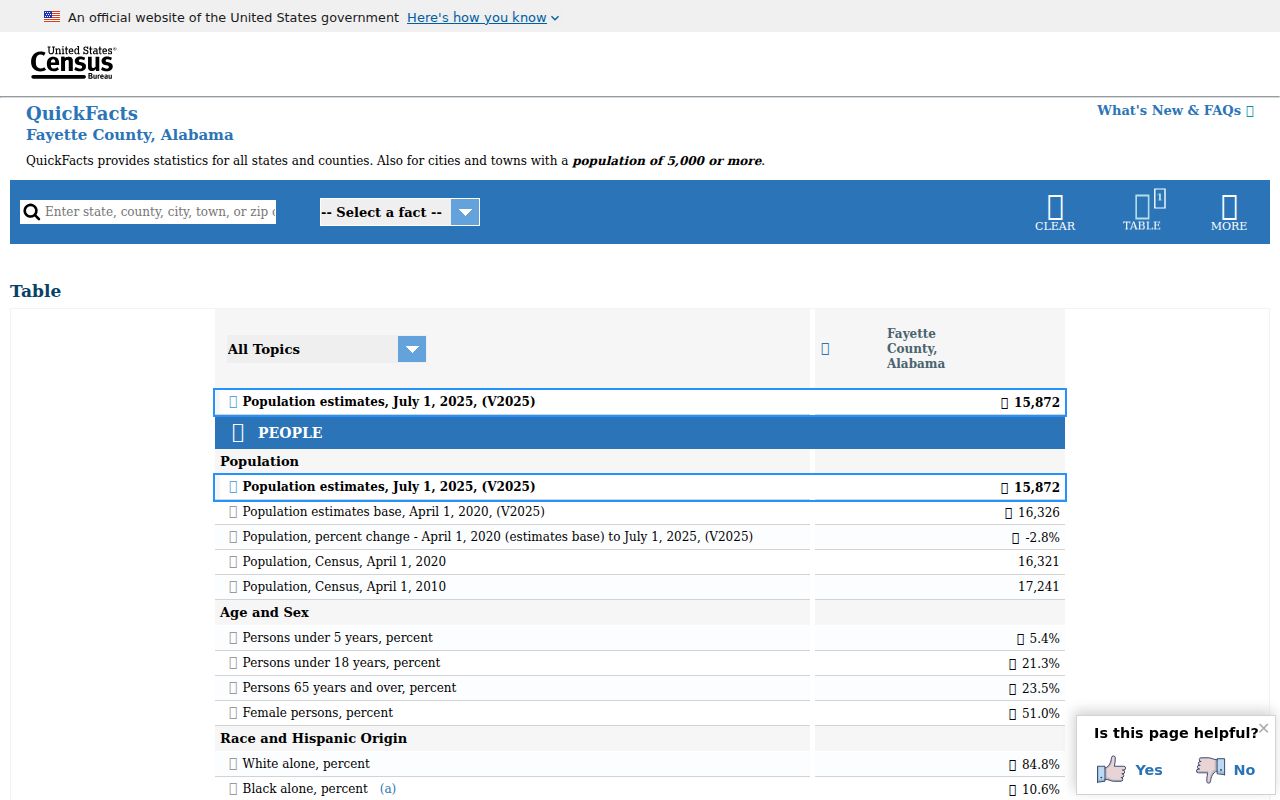
The distance between communities helps explain why sheriff, city police, municipal court, and county court access points all matter.
The ALEA crime-statistics program supplies a historical context, not a personal record search.
Fayette County's extractable 2016 aggregate reported 120 index crimes, but UCR participation is voluntary and old totals should not be treated as a current safety rating or proof about any person.