
Checking Criminal History in Fayette
Start with the event, not a broad name search. Fayette Police Department creates incident and arrest reports for matters it handles inside the city. Fayette Municipal Court keeps its own city case file. A charge filed in Circuit or District Court belongs with the Fayette Circuit Clerk. A fingerprint-based personal review goes through the Alabama Law Enforcement Agency, not the city. These channels may refer to the same event, but each answers a different question.
A sound Fayette criminal records search follows the record from its source:
- Contact Fayette Police Department for a local incident or arrest report and ask what identifying details are needed.
- Ask Fayette Municipal Court whether a city charge produced a municipal file, setting, payment entry, or disposition.
- Use the Fayette Circuit Clerk for Circuit or District Court case-action summaries, judgments, dispositions, and certified copies.
- Check the sheriff's custody channel for a recent booking, without treating custody data as the court's final result.
- Use ALEA's fingerprint and identification process to review your own statewide Alabama criminal history.
The broader Fayette County criminal history overview explains county and state sources in more depth. City channels remain the best first stop when the event began with Fayette police or municipal court.
Fayette Police Records Start Here
The official Fayette Police Department page lists the department at 118 1st Avenue NE, Fayette, AL 35555. The office phone is 205-932-5312, and published hours are 8:00 a.m. to 4:00 p.m. Monday through Friday. Fayette directs night and emergency calls to 911. Chief Danny Jenkins is named on the Fayette page.
The official police page also provides the clearest visual reference for the local department:
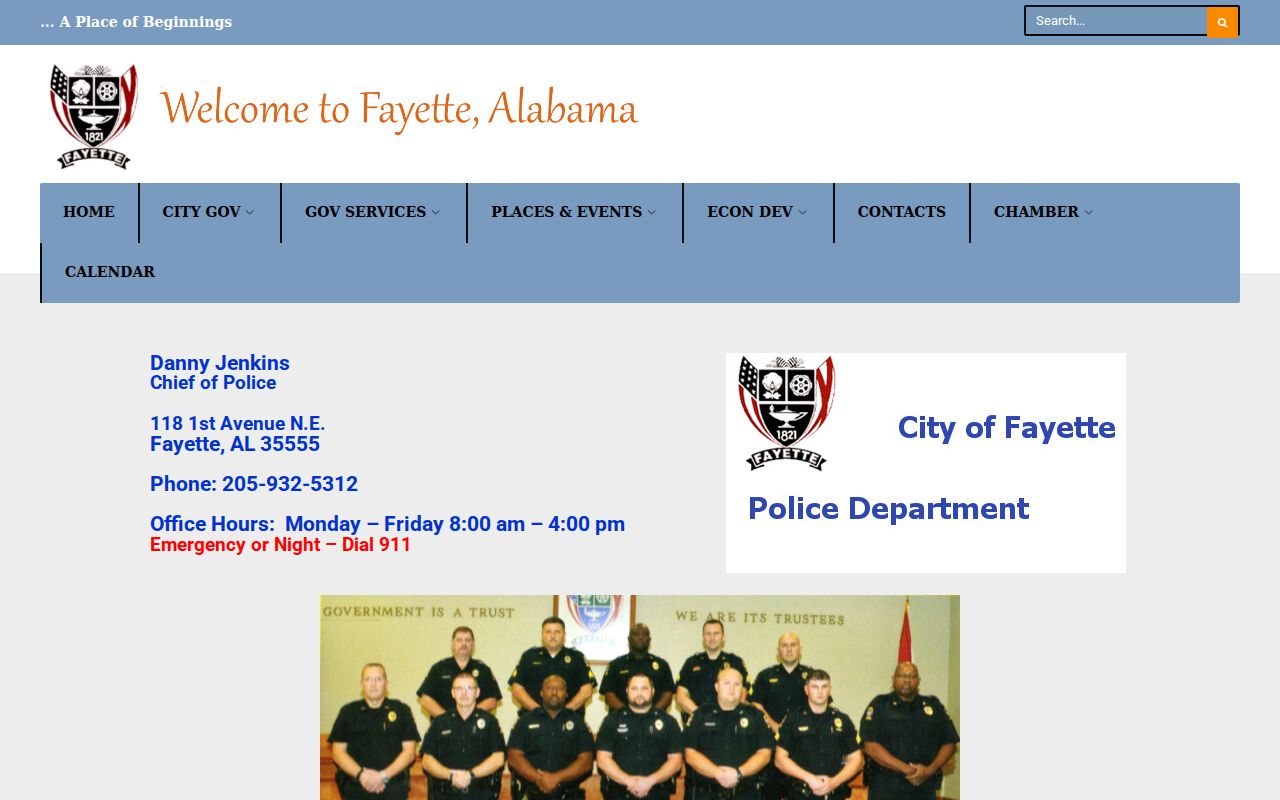
That office is the practical starting point for a Fayette police report, but the city publishes no dedicated records email, request form, copy fee, turnaround time, arrest blotter, app, or crime map. Ask the department what it can release and how to submit the request. Do not assume that a missing online form means the underlying record does not exist.
Fayette Police Department
118 1st Avenue NE
Fayette, AL 35555
205-932-5312
Monday through Friday, 8:00 a.m. to 4:00 p.m.
Fayette Police Department Records
Fayette police records document the agency's own work. An incident report may describe the call, location, people involved, and officer response. An arrest record may add alleged charges and custody details. Neither record proves how a prosecutor filed the matter or how a judge resolved it. For that result, move to the court that received the charge.
When contacting Fayette police, describe the record by event date, location, report number if known, and your connection to the record. Release limits may apply to confidential, juvenile, victim-identifying, investigative, or security-sensitive material. The Alabama Open Records Act provides a right for Alabama residents to inspect and copy public records unless another rule permits withholding. The city may redact protected parts rather than release a full police narrative.
Note: A Fayette police report and a Fayette criminal court file may concern the same event but contain different facts and status information.
A requester should also separate a report copy from a broad local history request. The department may be able to locate one known event from a date and place even though it publishes no public name index. If the goal is to review your own Alabama criminal history across many agencies, the ALEA fingerprint process is the better fit. Fayette police can speak only for records the department created or holds.
Fayette Court Portal Is Payment
The Fayette GovtPortal can look like a case lookup at first glance, but it is a payment channel. Its Fayette Municipal Court tile says “Pay Here.” A voice payment option is available at 855-909-9880, and the portal displays the court phone, 205-932-2086, and court@fayetteal.org. It does not show a public defendant-name, case-number, or citation-number search before payment.
The Fayette portal's captured screen helps identify the distinction between access and payment:
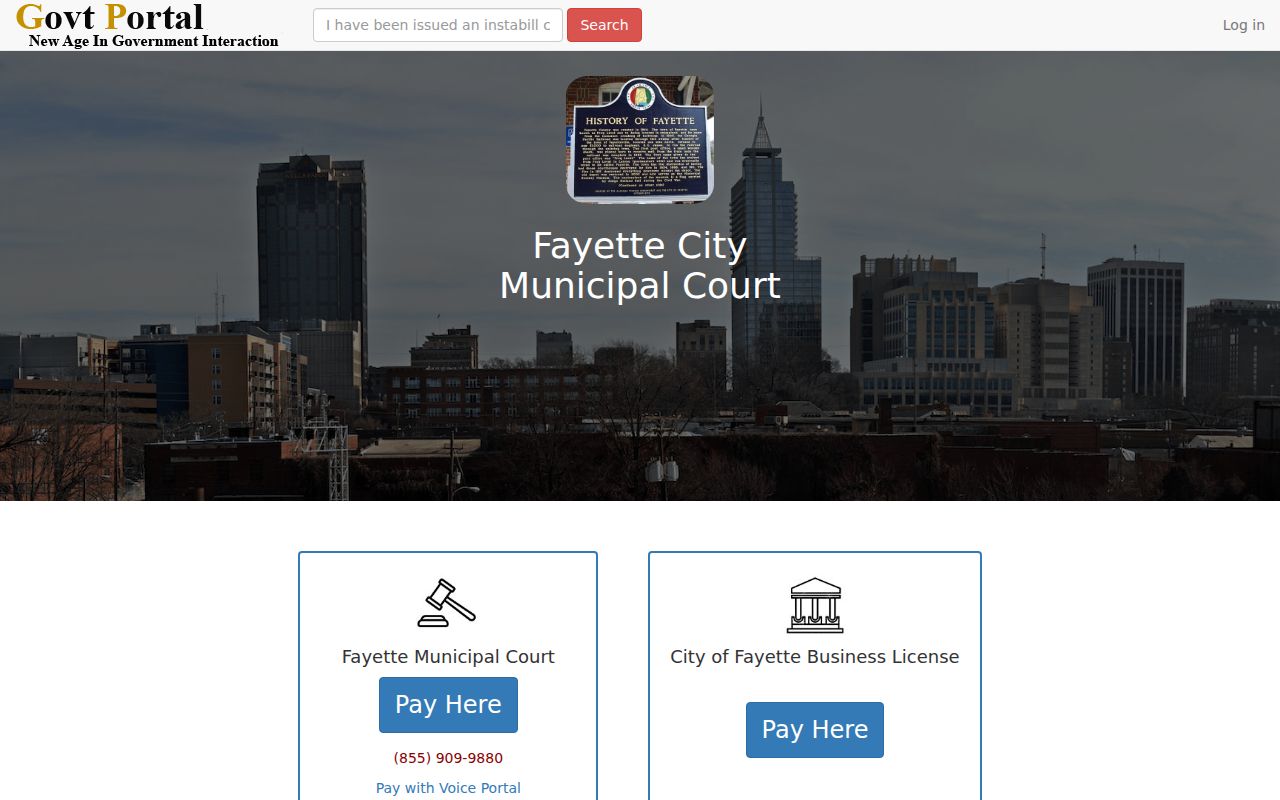
Use the phone or email for a record inquiry. Do not enter payment details merely to test whether a Fayette case exists. The city has published these service controls:
| Portal element | Purpose |
|---|---|
| Municipal Court tile | Payment workflow, not a public docket |
| Voice portal | Payment by calling 855-909-9880 |
| Court contact | 205-932-2086 and court@fayetteal.org |
| Business License tile | Non-court city service |
Fayette Arrests and Bookings
Fayette Police Department can create an arrest report, while the agency that receives a person in custody creates the booking record. The research found no official city page stating that Fayette has a holding cell or that every Fayette arrest goes to the Fayette County Jail. That gap matters. The correct custody source depends on where the person was taken, and a recent arrest may appear in police records before a court file is available.
A booking entry may show intake identity, booking date, initial charges, bond, release status, and a booking image. Those details are a custody snapshot. Charges can change after review, and a later court disposition may not appear in the booking feed. For county-wide arrest and custody channels, use the Fayette County arrest lookup.
Custody gap: No official Fayette source publishes a universal city booking route. Confirm the holding agency with Fayette police or the sheriff.
Reading Fayette Police Crime Records
The FBI Crime Data Explorer identifies Fayette Police Department as ORI AL0320100. Its 2024 monthly actuals total seven violent offenses with two clearances and 55 property offenses with 19 clearances. These figures describe offenses reported through the federal series, not the number of Fayette residents with criminal records and not the municipal court's full workload.
The Fayette violent-crime series shows the source totals:
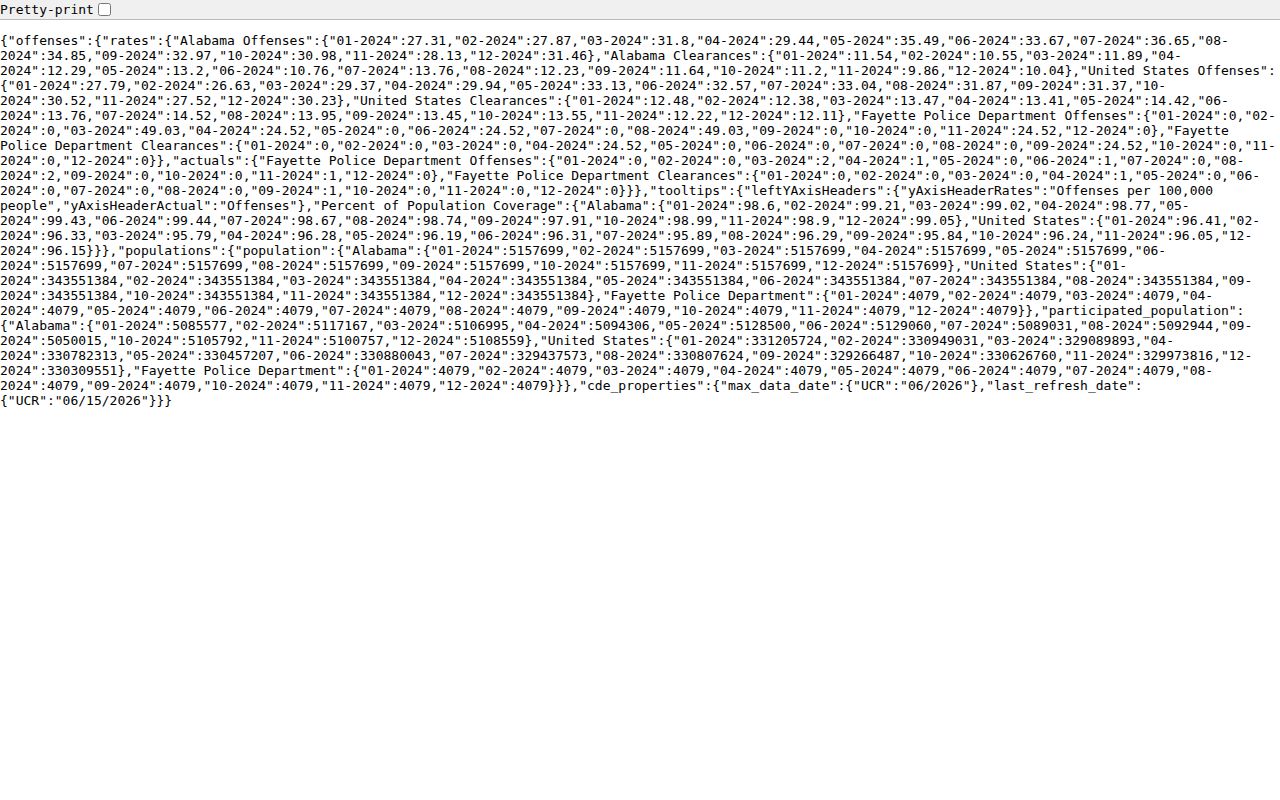
Those totals offer local context, but they cannot identify a case or person. The matching Fayette property-crime series provides the second category:
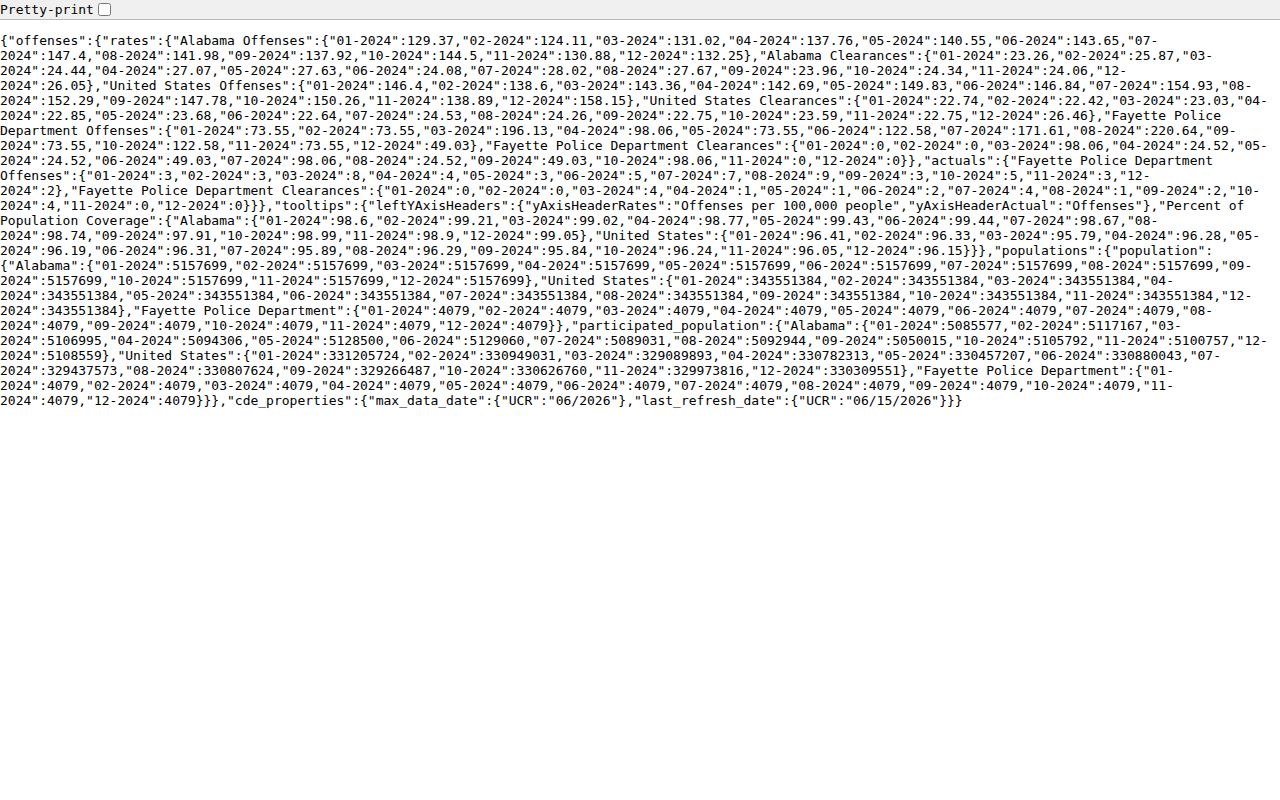
The two images reinforce the same point: agency totals are a trend source, while a Fayette criminal record search must use police, court, custody, or ALEA channels. Voluntary UCR participation and changes in reporting also limit comparisons across years.
Municipal Court Records in Fayette
Fayette Municipal Court handles misdemeanor charges that occur within city limits, along with city-level traffic and ordinance matters within its authority. The county clerk's warrant page confirms that city-limit misdemeanor charges go through municipal court. A municipal file can show the charge, settings, plea, payment or financial entries, and disposition kept by that court.
| Court | Fayette Municipal Court |
|---|---|
| Case types | City-limit misdemeanors, municipal ordinance matters, and traffic cases within city authority |
| Record channel | 205-932-2086 or court@fayetteal.org; no public online case search located |
| Payment channel | GovtPortal tile or voice payment at 855-909-9880 |
| Possible file contents | Charge, settings, plea, financial entries, and disposition |
| Copies and fees | No city copy fee or record-request form was published |
For a case filed in Circuit or District Court, contact the Fayette Circuit Clerk instead. The clerk keeps Criminal, Traffic, Juvenile, and Warrants divisions at the county level and can address case-action summaries, dispositions, judgments, and certified copies.
When Fayette Warrant Records Surface
The Fayette Magistrates and Warrants page gives a narrow official instruction. Someone who thinks a warrant may exist should appear personally at the sheriff's department or municipal police department. The page does not offer a public warrant-name search. This is one reason a payment portal or ordinary case search should not be treated as a complete warrant check.
Do not attempt to resolve a suspected warrant by sending sensitive personal details through an unrelated form. Contact Fayette Police Department and follow its directions for a personal appearance. Court-issued warrant information may also belong with the court that issued it. Warrant records can be confidential until the warrant has been executed, so an office may limit what it confirms by phone or email.
If a Fayette warrant leads to an arrest, keep the stages distinct. Police or sheriff records document service and custody. The municipal or county court file then tracks the charge, settings, and outcome. Checking both sources can explain why an executed warrant no longer appears as active while the related case remains open.
Where Fayette Records Go
A Fayette event can produce several records over time. Police create the initial incident or arrest report. A holding agency creates the booking entry. Fayette Municipal Court keeps a city case, while state charges filed beyond municipal jurisdiction reach Fayette County Circuit or District Court. Fingerprints and later disposition reporting can connect the arrest cycle to ALEA's Criminal Records Identification Unit.
Record flow: Fayette Police Department › Fayette municipal or Fayette County court › Alabama Law Enforcement Agency
Timing explains many mismatches. A new police report may not yet have a filed case. A booking feed may still show an initial charge after the court record changes. ALEA warns that older, nonautomated, unsubmitted, lost, or destroyed material may be absent from a statewide CHRI review even when a local file survives. Corrections should begin with the office that originated the disputed entry.
For county-filed cases, the Just One Look service offers account-based Alabama trial-court access by name or case number. The observed price was $9.99 for a search that includes one case detail, and a no-match still counts. Call the Fayette Circuit Clerk for old files, certification, or a portal miss. Use ALEA's $25 fingerprint packet when reviewing your own identity-linked statewide history.
Fayette Records Follow Civic History
The City of Fayette history says settlement began in 1821. The place was known as Fayette Court House or Fayetteville before incorporation on December 8, 1880, with a half-mile boundary around the courthouse. That history helps explain why city and county record channels sit close together in name yet remain separate in legal custody.
The Fayette history page preserves this local setting:

Historical research should start by identifying whether the event belonged to the municipality or Fayette County. Older city police material, municipal dockets, and county clerk records may have different retention and access paths. No published Fayette page gives an archived-year range, so ask the responsible office rather than assuming every old file has been digitized.
Fayette Booking Records Need Verification
A Fayette arrest does not prove which agency held the person. No official city source names a city jail, holding cell, or standing booking agreement with Fayette County. Ask Fayette Police Department where custody transferred, then use that holding agency's record. This direct check prevents a no-result in one roster from being mistaken for proof that no arrest occurred.
The same caution applies to court routing. A city-limit misdemeanor may remain in Fayette Municipal Court, while a felony or other state case can reach Circuit or District Court. Location, charge level, and filing decision determine the route. The arresting agency's first label is not always the final filed charge.
When a roster search misses, ask which agency received the person and on what date. Release, transfer, and data timing can all change what a current-custody feed shows. A court disposition may remain available long after the person leaves custody, making the clerk the stronger source for the lasting result.
Note: Verify the holding agency and filing court separately because Fayette booking records and case records answer different parts of the same event.
Public Access Rules in Fayette
Public access depends on the record and its custodian. Ordinary adult Fayette court information may be available from the clerk or Alabama's paid Just One Look service. Police records remain subject to state public-record rules and specific confidentiality limits. Juvenile, youthful-offender, expunged, victim-identifying, and security-sensitive material may be withheld or redacted. A public court entry is not the same product as fingerprint-verified statewide criminal history.
Key statutes:
Ala. Code §36-12-40 gives Alabama residents a right to inspect and copy public records unless law provides an exception.
Ala. Code §41-9-601 penalizes false-pretense acquisition or unauthorized communication of offender information.
Ala. Code §§15-27-1, -2, and -7 govern eligibility and access limits for Alabama expungement records.
Request only the Fayette record needed and use it for a lawful purpose. When an entry appears incomplete, confirm it with the originating police department, court, or repository before relying on it.