
Fayette County Criminal Court Cases
Fayette County criminal court cases are divided by jurisdiction. Circuit Court hears felonies and related misdemeanors under Alabama Code §12-11-30. District Court handles ordinary state misdemeanors, felony preliminary hearings, and some noncapital pleas under §12-12-32. Municipal courts keep ordinance matters and applicable misdemeanors arising within their cities.
The Fayette Circuit Clerk keeps Circuit and District Court records. The clerk's office is at 113 North Temple Avenue, P.O. Box 906, Fayette, AL 35555. It is open from 8 a.m. to 5 p.m. Monday through Friday and can be reached at 205-932-4617. City court files remain with the relevant municipal court, so the place of the alleged conduct can matter as much as the charge label.
Where Fayette Charges Go
A felony case belongs in Circuit Court, while a felony's first hearing may occur in District Court. Judge Samuel Junkin's Circuit Court office is at 103 North Temple Avenue and lists 205-932-3169. District Judge Merrell Nolen's office uses the same street address and lists 205-932-4613.
This split can cause one event to leave entries at more than one stage. A misdemeanor may instead stay in District Court or move through a city court if municipal jurisdiction applies. Searchers should not assume that a missing Circuit Court result means no Fayette County criminal case exists. The charge level, filing choice, and court jurisdiction decide where the docket is kept.
The 24th Judicial Circuit District Attorney prosecutes state charges in Fayette, Lamar, and Pickens Counties. Its Criminal Investigation Division may help develop a case before filing, but the clerk's docket is the source for the charge actually placed before the court. Municipal prosecutors handle city cases instead. This division of work is another reason to identify both the arresting agency and the court before requesting a Fayette County case file.
Searching Fayette County Case Records
Just One Look, also called Alacourt Access, provides paid, account-based access to Alabama trial-court case detail. It offers Name and Case Number search modes and charges $9.99 for one case. The system can show status, settings, parties, financial history, and a case-action summary. It is docket access, not a fingerprint-verified ALEA criminal history.
- Open Just One Look and create an account or sign in.
- Choose Name when the number is unknown, or Case Number when it is known.
- Review the match before paying, since access is sold one case at a time.
- Read the status, settings, parties, financial history, and case-action summary together.
- Call the Fayette Circuit Clerk for certification, images, older files, or an unclear entry.
| Field Label | Type | Required | Notes |
|---|---|---|---|
| Search mode | Choice | Yes | Name or Case Number |
| Name | Text | For name mode | Check the match before purchase |
| Case number | Text | For number mode | Do not infer a Fayette format |
| Account | Login | Yes | Paid, account-based access |
| Case purchase | Payment | Yes | $9.99 for one case |
Fayette Docket Search Limits
The Alacourt subscription service is another court-access product, but its public-facing page is a login screen. The source image below shows that access gate. It helps explain why a Fayette County criminal case search may require an account rather than a free open index.
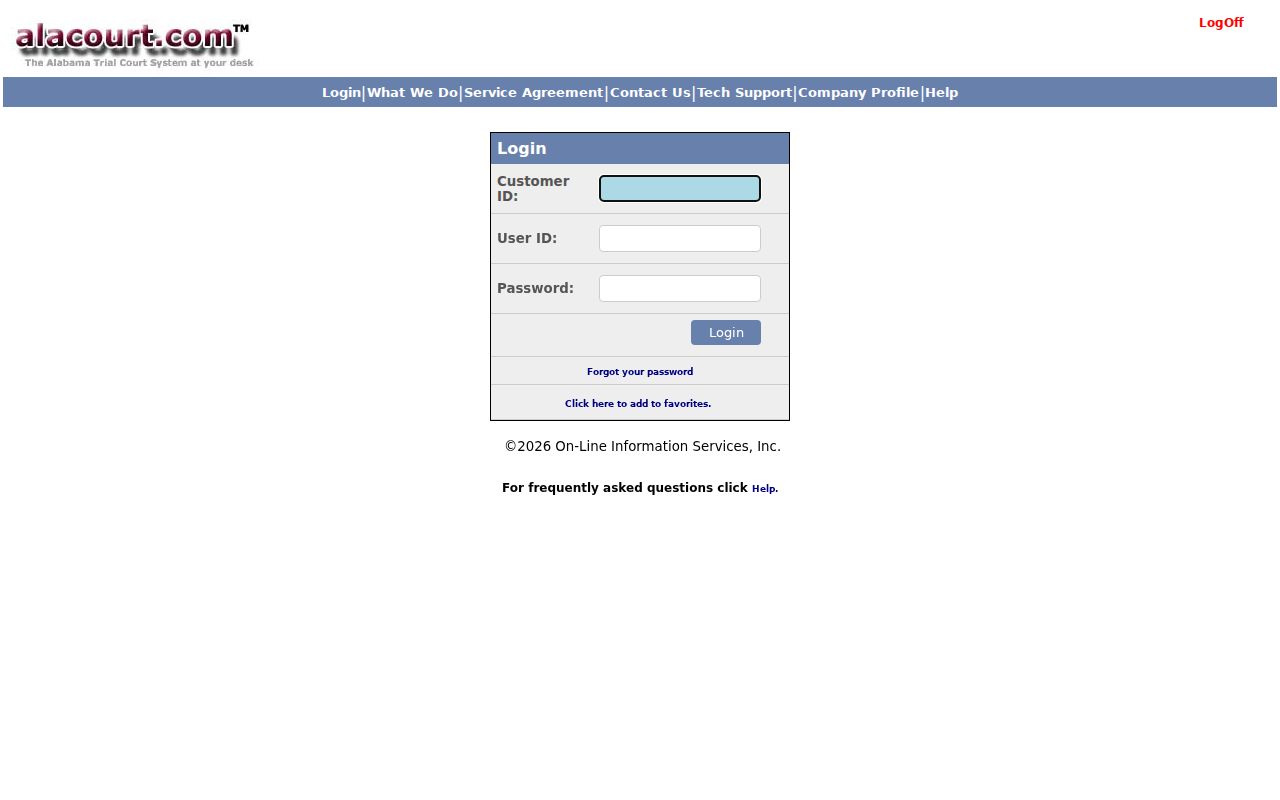
The login image does not prove that a case exists. If no online match appears, call the Fayette Circuit Clerk. Staff can address older records, certified copies, available images, and ambiguous docket entries. No published source establishes a local case-number pattern or document-copy fee, so those details should be confirmed with the office.
Inside a Fayette County Case File
A Fayette County court file focuses on what was filed and what the court did. Read charge documents and later docket events together. A booking charge can change before prosecution, and a final disposition may differ from the first allegation.
| Case Number & Court | Identifies the docket and the court with jurisdiction. |
|---|---|
| Charging Document | Records the charge filed by complaint, indictment, or other allowed process. |
| Docket Entries | Lists settings, actions, filings, and the case-action summary. |
| Hearing Dates | Shows scheduled court settings and recorded events. |
| Disposition & Judgment | States the charge outcome, such as dismissal, acquittal, plea, or conviction. |
| Sentence & Conditions | Records the court's post-conviction order when one exists. |
The charging document deserves a separate read from the case-action summary. A complaint can begin a prosecution, while an indictment reflects a grand-jury charge. Grand-jury work itself is secret, but an unsealed indictment and the resulting docket may become public. The action summary then records what happened after filing and each later court event. That sequence helps a reader distinguish the offense first placed before the court from a later amended charge, plea, dismissal, judgment, or sentence.
Reading Fayette Case Outcomes
A disposition is the outcome of a charge. An acquittal means the prosecution did not prove guilt. A nolle prosequi means the prosecutor ended a charge subject to its legal status. A dismissal with prejudice ordinarily cannot be refiled, while one without prejudice may be filed again.
Do not read a setting or a financial entry as the final result. The case-action summary should be checked for the last disposition and sentence entries. A plea is a formal response to a charge; a plea agreement is a negotiated resolution. Restitution is payment ordered for a qualifying loss. Concurrent terms overlap, while consecutive terms run one after another.
These court terms matter because arrest, charge, and conviction are distinct events. For the earlier custody record, use the county's arrest lookup; use the court file to learn what prosecutors filed and how the judge resolved it.
How a Criminal Case Moves
A typical Alabama case progresses through a set of legal steps, though the research does not publish a Fayette County timetable. An arrest or initial appearance can be followed by a complaint, indictment, or information where allowed. Arraignment records the plea. Pretrial work may include motions and settings before a plea or trial produces a disposition.
Case flow: Charges Filed › Arraignment › Pretrial › Plea or Trial › Disposition › Sentencing
An appeal may follow. The docket should be read in date order because a later order can alter an earlier setting. A dismissal or acquittal is not a conviction, yet an arrest or booking artifact may remain until it is legally expunged.
When Fayette Search Finds Nothing
A blank portal result is not a final answer. Check the spelling and whether the matter belongs in Circuit, District, or municipal court. Then contact the Circuit Clerk's criminal records office at 205-932-4617. Ask whether the file is older, indexed under another entry, available only as an image, or held by another court.
Fayette Circuit Clerk
113 North Temple Avenue
P.O. Box 906
Fayette, AL 35555
205-932-4617
8 a.m. to 5 p.m., Monday through Friday
Provide a full name and case number if known. Ask what the clerk can certify and whether any copy cost applies before ordering. Published research does not state a Fayette document fee. This counter and phone channel are the sound fallback when paid online access does not settle the question.
Fayette Docket and Copies Compared
Online docket detail, the court file, and a certified copy serve different needs. Just One Look is useful for locating a Fayette County criminal case and reading its status, settings, parties, financial history, and action summary. The clerk's file may supply available pleadings or images that the paid view does not settle.
A certified copy is the clerk's authenticated version of a specific record. Ask for it when the receiving office requires certification. The research does not publish Fayette County copy or certification prices, so confirm the item, format, and current cost before placing an order. This distinction prevents a search-result screen from being mistaken for the official filed document.
Case Record Access & Restrictions
Alabama Code §36-12-40 recognizes an Alabama resident's right to inspect and copy public records unless another law applies. Court access still has firm limits. Juvenile, Youthful Offender, expunged, victim-identifying, and security-sensitive material may be confidential or redacted. Unserved warrants are also restricted.
Online detail may not equal the complete paper or electronic court file. Authorized access can remain for courts, law enforcement, the subject, an attorney, or a person acting under a court order even when public search is blocked. False-pretense acquisition or unauthorized communication of offender information can bring serious penalties under §41-9-601.
Unserved warrants present another Fayette County limit. The local magistrates page states that an arrest warrant is not public until it has been served. A served warrant may later appear in a docket or custody record, but an unserved, sealed, or juvenile warrant will not be part of an ordinary public result. Ask the issuing office about access rather than relying on the absence of an online entry.
Expunged Alabama records are withdrawn from ordinary public results and kept in a protected archive subject to statutory exceptions. When a Fayette County criminal case cannot be found, the proper course is to ask the clerk whether access is limited. Do not infer that the case never existed or that a listed person was convicted.